
The choice of an activity for children is not just about finding “something to do.” We recommend starting from a criterion that is often overlooked: the degree of real autonomy that the activity allows. An occupation that requires the constant presence of an adult does not serve the same purpose as a setup where the child progresses independently, makes decisions, and regulates the duration of their engagement themselves.
Child autonomy: the criterion that separates passive occupation from educational activity
An activity generates autonomy when it meets three conditions: a short initial instruction, manipulable materials without assistance, and a visible result for the child themselves. Guided coloring, for example, ticks these boxes. An elaborate baking workshop, on the other hand, keeps the adult in a position of constant supervision.
The High Council for Public Health has also evolved its doctrine on screens: rather than a rigid hourly threshold after age 3, French recommendations now prioritize observing the concrete effects on sleep, mood, and interactions. The issue is not to count minutes but to identify what the screen is replacing. When a tablet replaces free play before bedtime or during meals, that is where the alternative must intervene.
Platforms like stationkids.fr offer fun and educational activities designed for children to progress at their own pace, which reduces dependence on adult supervision while maintaining a structured framework.
Unstructured free play: an educational goal, not a void to fill
We often observe a confusion between “occupying” and “educating.” A study by Colliver et al. published in 2022, cited by Psychologies in September 2026, confirms that unstructured free play constitutes a legitimate educational goal. Allowing a child to manipulate everyday objects, invent a scenario, or build without a model develops emotional skills that directed activities do not cover.

The reflex to fill every free slot with a structured activity produces the opposite effect of what is sought. The child loses their ability to self-occupy and demands a permanent program, pushing parents towards the screen solution.
Specifically, we recommend distinguishing three types of time slots during the day:
- Directed moments (craft workshop, board game, nature outing) where the adult sets the framework and actively participates.
- Semi-autonomous moments (free drawing with prepared materials, building with blocks, symbolic play) where the adult initiates the activity and then steps back.
- Pure free play moments (no instructions, no imposed materials) where the child chooses their own occupation, including temporary boredom.
A ratio of about one-third for each type during a vacation day works better than a succession of workshops without breaks.
Alternative activities to screens: targeting critical moments
Not all time slots are equal. Health recommendations emphasize three contexts where the screen directly encroaches on an important function: mealtimes, the bedroom, and the period before falling asleep. It is in these specific slots that the replacement activity should be considered.
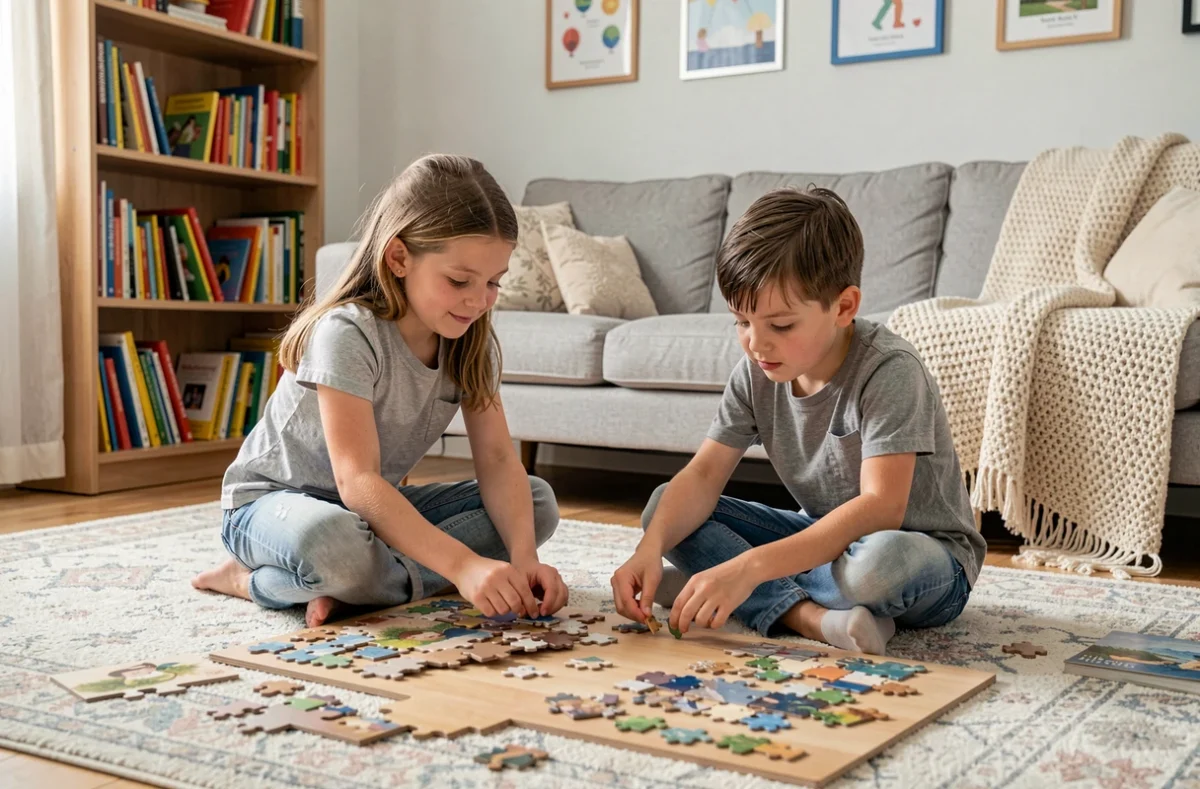
Before bedtime, a calm sensory activity (modeling, puzzle, shared reading) lowers the level of excitement. During meals, a verbal language game (riddles, endless sentences, object description) replaces the visual stimulation of the screen with social stimulation.
The difficulty lies in consistency. A child accustomed to screens during these time slots will resist in the first few days. We observe that it generally takes one to two weeks of consistency for the new routine to settle without conflict.
Nature activities and local outings: an underutilized resource
The Bordeaux program “Growing up with screens,” documented by Santé publique France in La Santé en action n° 474 (2026), combines parental awareness with concrete access to cultural and sports activities supported by local communities. This approach opens a rarely addressed avenue in lists of at-home activities.
Media libraries, municipal toy libraries, shared gardens: these structures offer free or low-cost workshops, adapted by age group, with professional supervision. Local communities become a concrete resource for diversifying non-digital activities.
Concrete criteria for choosing a fun and educational activity
Before selecting an activity, we recommend filtering it through five operational criteria:
- Realistic duration: does the activity match the child’s attention span (often overestimated by parents)?
- Available materials: is everything already at home, or is a prior purchase needed that will delay implementation?
- Level of autonomy: can the child continue alone after the launch, or is the adult necessary from start to finish?
- Integrated learning: does the activity engage fine motor skills, language, creativity, or logic without the child feeling like they are “working”?
- Adaptability: can the activity be simplified or made more complex for a sibling of a different age?
A free construction game meets these five criteria. A home chemistry workshop meets only two or three (low autonomy, specific materials). The most effective activity is not the most spectacular but the one that will actually be used.
The European regulatory framework for toys will evolve in the coming years, which will impact the design of educational materials available on the market. Checking compliance with current standards remains a basic reflex when making any purchase.
Choosing an educational activity for a child comes down to balancing what pleases the adult and what works for the child. The best indicator remains the time during which the child continues the activity without seeking help, not the aesthetics of the final result.