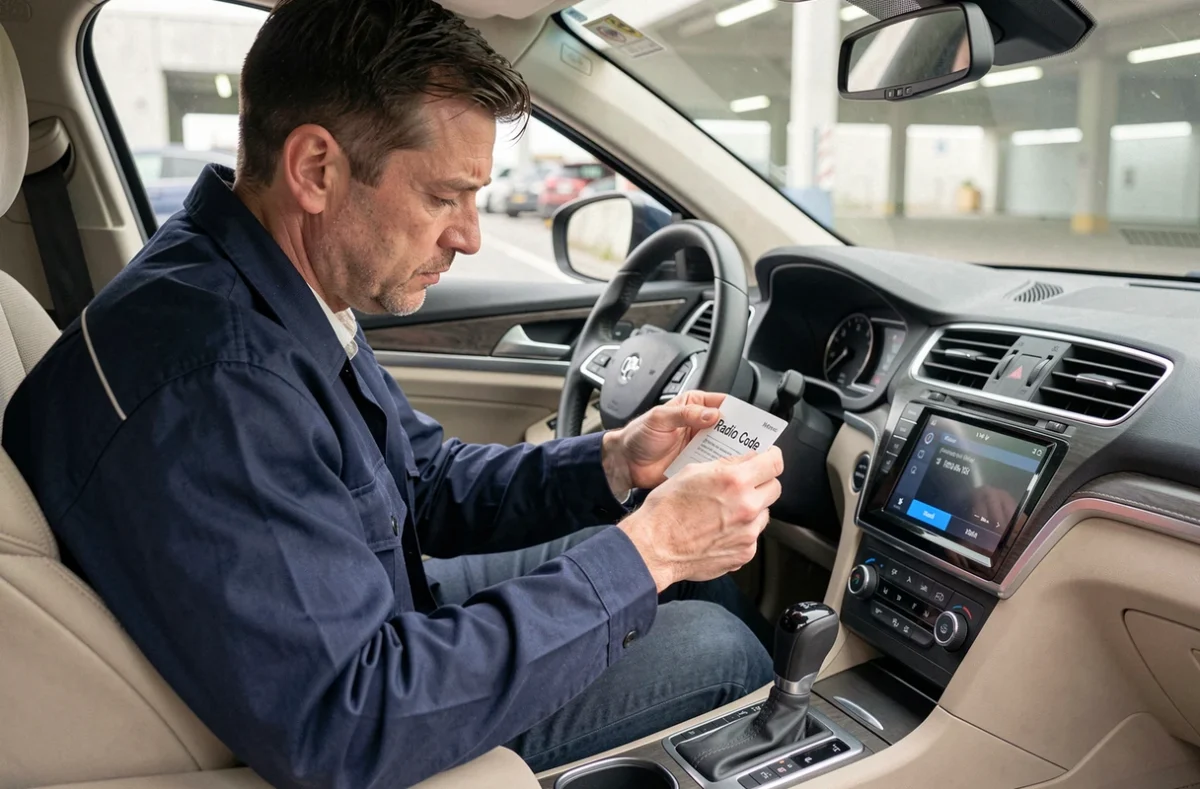
When a vehicle’s battery is disconnected or replaced, the car radio loses its power supply and triggers an anti-theft mechanism. The screen then displays “CODE” and the unit remains silent until a sequence of four digits has been entered. This radio code is unique to each device, and the procedure to retrieve it varies depending on the brand, the year of the vehicle, and the type of onboard multimedia system.
Precode and serial number: two references not to be confused
Before searching for the code, it’s essential to understand what the radio expects. The code itself is a combination of four digits, programmed at the factory. To find it, two identifiers are useful, but they do not serve the same purpose.
The serial number is engraved on the radio’s casing, often on a side or rear label. It uniquely identifies the device and allows the manufacturer or a specialized service to trace back to the original code. Reading it typically requires partially disassembling the unit or at least extracting it from its housing using extraction keys suited to the format.
The precode, on the other hand, is a shorter identifier (a letter followed by three digits in the case of Renault, for example). It serves as a calculation key to generate the final code via a manufacturer-specific algorithm. On some models, it is displayed directly on the screen by holding a combination of buttons when starting the unit.
Knowing the difference between these two references saves time: a site that requests the precode will not work if you provide the complete serial number, and vice versa. Before taking any steps, it is possible to retrieve the radio code for free by first identifying the correct reference on the unit or in the vehicle’s documents.

Where to find the radio code without disassembling the unit
The quickest solution does not involve a screwdriver. Several locations contain the code, provided you know where to look.
- The maintenance and warranty booklet: for Renault vehicles registered before May 2010, the code is on a “C.A.R.” sticker on the back cover of the booklet. This sticker is often overlooked because it does not resemble technical information.
- The vehicle purchase invoice: for Renault vehicles registered after May 2010, the code is mentioned on the original invoice. It sometimes appears in a section dedicated to accessories or standard equipment.
- The logbook or manufacturer folder: other brands (Volkswagen, Ford, Fiat) include a plastic card or sticker in the folder provided with the vehicle. This document is frequently lost during resale.
If none of these documents are available, the next step is to contact the manufacturer or an authorized dealer. The serial number of the unit or the vehicle’s VIN (visible on the registration document, line E) allows them to retrieve the code from their database. This process is free with some manufacturers and may incur a fee with others.
Renault chatbot and online tools: free procedures depending on the brand
The Renault brand has recently introduced an official chatbot capable of providing the original code without going through a dealer or disassembling the radio. This procedure, documented on the Renault Group community, serves as a direct alternative to third-party precode conversion sites. It only requires the identification of the owner via their My Renault account.
This approach has a concrete advantage: it eliminates the risk of encountering an online analysis service that charges for a service that the manufacturer offers for free. Several sites indeed offer to “calculate” the code from the precode for a few euros, while the information is accessible at no cost from the source.
Connected multimedia systems: a different logic
On recent vehicles equipped with systems like openR link, the concept of a classic radio code no longer applies. The radio is integrated into the connected multimedia system, and services are linked to the user account via the My Renault app. After a battery change on these models, the issue will not be a four-digit code but potentially a reconnection of the digital account to the vehicle.
Before searching for a code, it is therefore necessary to identify the exact type of system installed. A mechanical code unit (rotary buttons, basic LCD screen) and a connected system with a touchscreen do not follow the same recovery procedure at all.
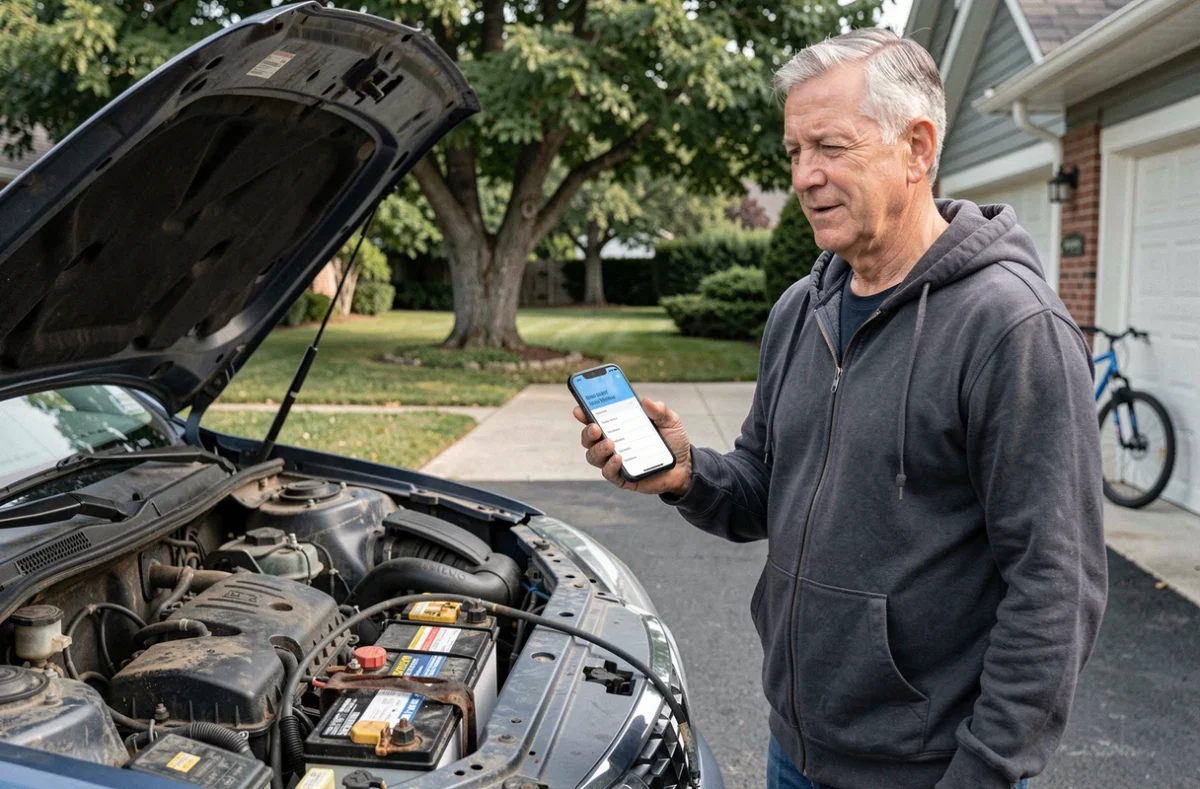
Entering the radio code: input errors and temporary lockout
Once the code is found, entering it seems trivial. It is not always so. Most car radios limit the number of attempts before a temporary or even permanent lockout.
- The input method varies by brand: on some Renault units, each preset button (1 to 4) corresponds to a digit of the code, and each position is incremented by pressing multiple times. On others (Dacia, Ford), input is done via the steering wheel buttons or a numeric keypad on the screen.
- After three incorrect attempts, many units impose a wait of several minutes to several hours before allowing another attempt. Some models require leaving the ignition on for the entire duration of the lockout.
- A permanent lockout after too many attempts may require a dealer intervention to reset the system. This case remains rare but costly in terms of time.
The simplest precaution: write the code on a piece of paper stored outside the vehicle, or save it in the digital maintenance booklet if the manufacturer offers one. After a battery change, the process then becomes a thirty-second formality.
The reflex to adopt before any battery replacement remains to check if the code is accessible. On a used vehicle whose manufacturer folder has disappeared, it is better to anticipate the search for the code rather than end up with a silent radio in a parking lot.