
Home sports coaching refers to the intervention of a qualified professional directly at the client’s location, with or without equipment, to supervise sessions tailored to their goals. This format has been undergoing a transformation accelerated by digital tools and the evolving expectations of practitioners, who seek more flexibility and personalized follow-up between sessions.
AI Coach and Human Coach at Home: A Coexistence Redefining the Profession
The emergence of AI-driven fitness coaching solutions changes the game for home coaching professionals. These platforms generate personalized training plans, automatically adjust the load based on recorded performances, and provide real-time feedback, all at a cost significantly lower than that of traditional human support.
See also : The latest trends and must-know news to make your wedding a success
The key point is not the direct competition between AI and flesh-and-blood coaches. Several platforms document a complementary use: AI prepares the sessions, ensures follow-up between visits, and analyzes progress, while the human coach focuses on posture correction, motivation, and real-time adaptation during the home appointment.
This division of roles reconfigures the value proposition of home coaching. A coach who ignores these tools risks having their clients compare their intersession follow-up (often limited to a message or a PDF) with the dynamic dashboard of an AI application. The news from Mon Coach A Domicile reflects this sector’s transformation, where technology does not replace in-person interaction but raises its standards.
You may also like : The latest business trends and innovations to watch for starting a business in Rennes
Specialization Niches for Home Sports Coaching
The generalist offer of home fitness is losing ground to more targeted niche positions. Recent market analyses show that specialized coaches more easily generate their first clients and achieve better retention than those offering a “one-size-fits-all” service.
Three axes of specialization stand out in home coaching:
- Post-rehabilitation or post-partum coaching, which requires skills in functional anatomy and communication with the client’s healthcare professionals.
- Physical preparation for independent seniors, focused on balance, fall prevention, and maintaining muscle mass, with low-impact sessions that can be performed in a living room.
- Mental health-oriented training, combining physical exercise with stress management or breathing protocols, in a holistic support approach.
Each of these niches meets a specific demand that mainstream applications do not cover, as they require in-person assessment and constant adaptation to the home context (available space, furniture, daily fitness level).
Connected Devices and Data: What Changes Home Sessions
Smartwatches, motion sensors, and body composition scales are no longer reserved for gyms. Their use at home allows the coach to have objective data before even arriving at the client’s location: resting heart rate, sleep quality, daily activity level.
This continuous data collection modifies the structure of sessions. The coach no longer starts with a standard warm-up: they consult the week’s data, identify a drop in recovery or a spike in stress, and adjust the day’s program accordingly.
The challenge remains the readability of this data. An effective home coach in 2026 does not just read a graph: they translate metrics into understandable training decisions for the client. The added value of the coach lies in interpretation, not in data collection.

Hybrid Format: Combining In-Person at Home and Remote Follow-Up
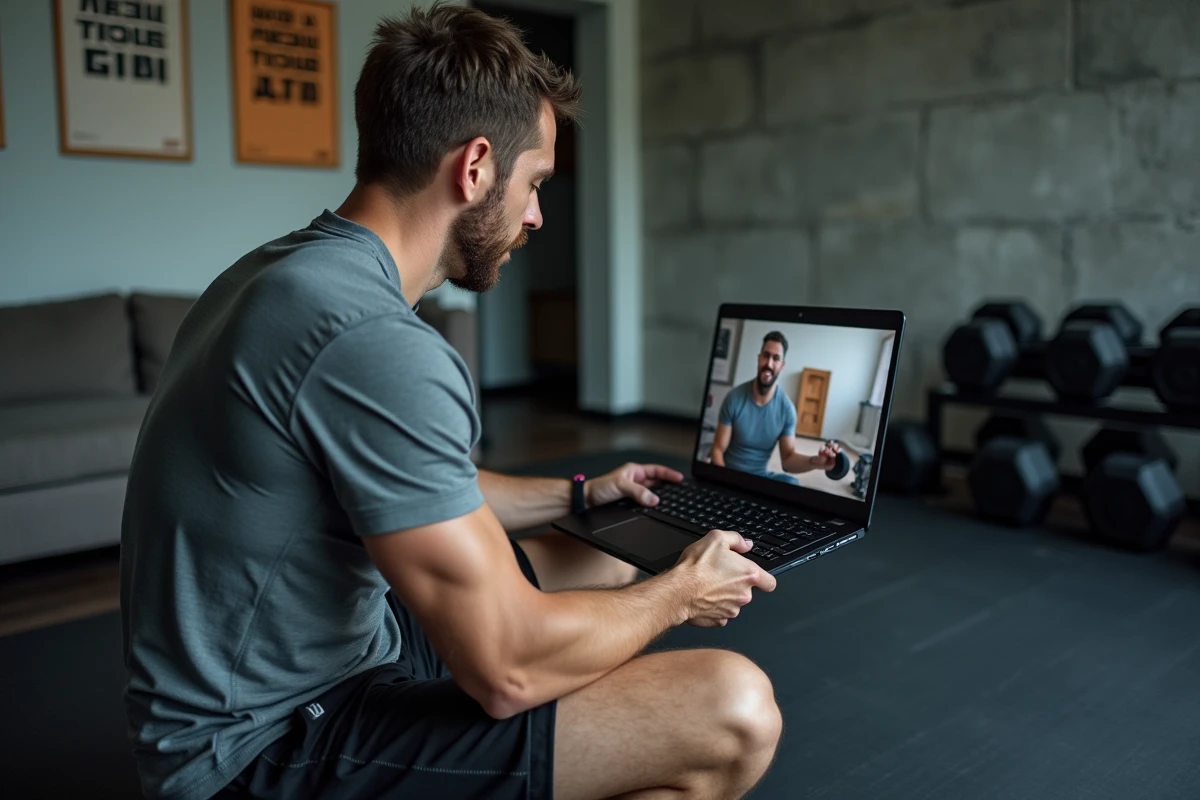
The purely in-person model (one to three sessions per week at the client’s location, with no contact in between) is gradually giving way to a structured hybrid format. The coach conducts one or two physical sessions at home and complements them with remote follow-up: programs sent via an app, video conferencing for technical check-ins, voice messages for corrections.
This format addresses two practical constraints. For the client, it reduces the overall cost of support while maintaining a high level of follow-up. For the coach, it allows them to manage more clients without multiplying travel.
The difficulty of the hybrid model lies in the coherence between the two modes. A home session focused on strength does not yield the expected results if the remote program prescribes cardio volume incompatible with recovery. Coaches who structure their hybrid weeks with a shared scheduling tool (accessible to the client in real-time) achieve better adherence than those who rely on informal exchanges.
Market Growth and Client Expectations in Home Coaching
The sports coaching market shows an annual growth rate classified as over 5%, driven notably by the demand for personalized and flexible services. The segment of home coaching and hybrid formulas accounts for a significant share of this dynamic.
Client expectations have evolved. Simply prescribing exercises is no longer sufficient. Practitioners are looking for:
- Support that integrates nutrition, stress management, and sports programming within a coherent framework.
- Real scheduling flexibility, with the possibility to reschedule or adapt a session without penalty.
- Tangible evidence of progress, based on measurable data rather than subjective feelings.
This demand pushes home coaches towards greater professionalization of their client follow-up, well beyond just the technical quality of the sessions.
Home sports coaching in 2026 is distinguished less by the location of practice than by the coach’s ability to articulate physical presence, digital tools, and specialization. Professionals who master this articulation attract a clientele ready to commit for the long term, where the generalist offer struggles to retain.